

Three Sizes, One Remarkably Interesting Poodle
Standard Miniature Toy Poodle differences
Three heights, familiar curls and a real-life choice that goes well beyond the size of the sofa.
There is a lovely familiarity to a Poodle at any size. Standard, Miniature and Toy Poodles differ most obviously in height. In the United Kennel Club (UKC) descriptions discussed here, the dividing measure is the top of the shoulders, not weight. The label helps you picture the dog; it does not choose its personality or daily routine for you.
Let’s compare the three height ranges, then consider the daily life and coat care behind each size. We’ll finish with the different family health records, so the choice stays connected to the individual Poodle.
Whichever size attracts you, there is a capable animal underneath the haircut. Grooming, handling and the right family health records deserve attention at every scale.
A NOTE FROM WATERSEDGE
We read the research, we talk to people who do this work, and we try to make complicated animal-health information easier to understand. What you're reading reflects how we've interpreted and organized what we found. It is educational, not veterinary advice, a diagnosis, or a treatment plan for your animal.
We're not perfect, and neither is the available research. Evidence changes, new work gets published, and what suits one animal may be wrong for another. Species, breed, age, weight and existing conditions all change the answer.
Use this as a starting point for your own reading and for the conversation with your veterinarian, particularly if your animal is on medication, is under treatment, has an existing condition, is pregnant, very young or very old, or if anything about their condition is changing quickly.
01 / First, let’s see where the sizes divide
First, let’s see where the sizes divide
The size names become clearer when we put a measurement beside them. UKC’s dated 2024–2025 standards use these boundaries:
- Standard: over 15 inches at the shoulders.
- Miniature: over 10 inches and no more than 15.
- Toy: 10 inches or less.
A dog exactly 15 inches is within the Miniature range; one exactly 10 inches is within the Toy range. UKC registers the Standard separately from its Toy and Miniature Poodle breed, so ask which registry a breeder is discussing.

“Over 15 inches” also leaves room for quite different-sized Standards. Meet adult relatives if transport, lifting or available space is important to your choice. Weight helps with equipment and body-condition discussions, but gaining weight does not move a dog into another height variety.
02 / Smaller doesn't mean effortless
Smaller doesn't mean effortless
The smaller varieties are still Poodles with a life to enjoy and care to receive. UKC’s standards describe a familiar square outline and characteristic coat across the sizes. Its Standard description also recalls water-retrieving work and participation in performance events. The hair is part of the portrait, not the dog's only occupation.
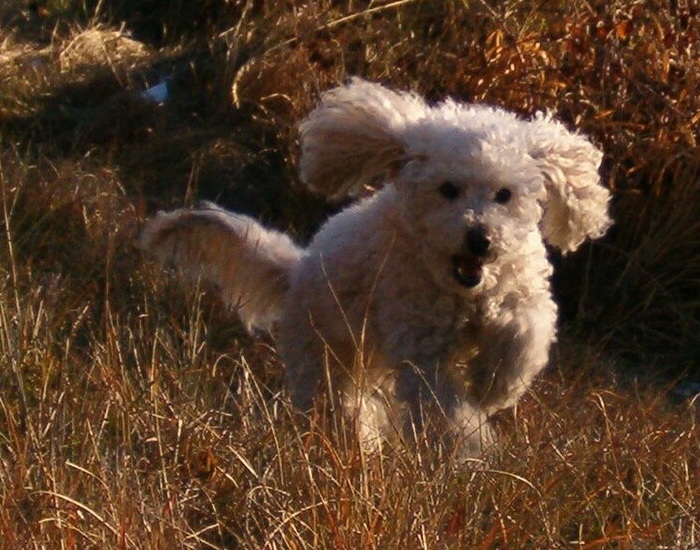
A smaller body may fit your travel arrangements more easily. It still needs learning, activity, respectful handling and dependable care. A taller dog does not automatically need extreme amounts of exercise, either. Ask about the actual dog's age, health, energy and habits.
Picture ordinary moments: getting into the car, sharing space with a much larger animal, being cared for by someone else. What changes at each size? Your stairs, working hours and household traffic may be more useful to discuss than a general “good apartment dog” label.
Ask people who live with the size you like what their dogs enjoy on a weekday. The answer can reveal companionship that a show photograph never quite captures.
03 / Every size comes with a coat
Every size comes with a coat
Whichever height catches your eye, the coat will be part of life together. Mary Kearl’s 2021 American Kennel Club (AKC) grooming article describes brushing through the coat and keeping longer hair free of mats. A Toy has less surface to groom than a Standard, but coat texture, chosen length and handling tolerance also shape the work.

Show a groomer the style you hope for and ask them to demonstrate the care for that size and coat. Discuss the time needed at home between appointments, the local grooming cost and transport arrangements. Every size needs a routine you can keep up. A short trim may simplify some work; it doesn't make grooming disappear.
04 / Match health records to the variety
Match health records to the variety
Health paperwork needs to match the variety you are considering. The Poodle Club of America’s December 2024 statement gives different breeding-screening lists. They are not evidence that one size is universally healthiest.
- Toys and Miniatures: DNA testing for the named PRCD form of inherited retinal disease, specialist eye examinations and kneecap assessment. Miniatures also have hip evaluation.
- Standards: hip, specialist eye and thyroid screening, plus DNA information for two named conditions: neonatal encephalopathy with seizures, an inherited brain disease, and von Willebrand disease Type I, an inherited bleeding disorder. For those two DNA results, the statement also accepts clear-by-parentage information: clearance based on the parents’ DNA results rather than a DNA test of that dog. A heart examination and a skin biopsy for sebaceous adenitis, a disease that inflames the skin’s oil glands, are additional elective checks. Ask the breeder and veterinarian to explain what each report covers.
Have unfamiliar names explained by the breeder and your veterinarian. DNA tests, examinations and imaging answer different questions; a long genetic panel cannot be assumed to replace them.
Request both parents' original results, including age and date, and ask what is known about relatives beyond those checks. These are breeding records, not a personalized care schedule or guarantee of lifelong health.
Meet the adults, understand the coat and read the family records. The best size is the one whose real daily life you can share, with room left to discover the individual Poodle.
KEEP EXPLORING
Recommended stories


Research details
UKC's internally dated 2024 and 2025 documents supply the measurements; their separate Standard registration is stated explicitly. The PCA statement is a breed-club screening policy, not a comparative health trial. Household examples do not establish temperament or workload measurements across sizes. No interviews were conducted.
Sources
-
United Kennel Club: Standard Poodle. Effective January 2, 2024; four-page official document.
-
United Kennel Club: Poodle. Effective January 1, 2025; Toy and Miniature registration and height descriptions.
-
Poodle Club of America: Health Statement. Internally dated December 11, 2024; variety-specific breeding screening.
-
Mary Kearl: How to Groom a Standard Poodle. American Kennel Club. Original publication February 17, 2021; practitioner-based educational reporting with affiliate disclosure.
UC Davis Veterinary Genetics Laboratory. Neonatal encephalopathy with seizures and von Willebrand disease Type I. Condition definitions; inspected October 15, 2026.
Orthopedic Foundation for Animals. Sebaceous adenitis and clear-by-parentage policy. Condition definition and explanation of parent-based clearance; inspected October 15, 2026.
Photo credits
Caniche Standard Parti-couleur.JPG. Photo: Teteaqueue, via Wikimedia Commons. CC BY-SA 3.0. JPEG re-encoded by WatersEdge; derivative shared under CC BY-SA 3.0. Photo source · License

Photo: smo ch, “Caniche-actif.JPG”, via Wikimedia Commons. CC BY-SA 3.0. Cropped and JPEG re-encoded by WatersEdge; derivative shared under CC BY-SA 3.0. Photo source · License

Photo: Wolfmann, Miniature poodle puppies at four and a half week (dvergpuddel-valper fire og an halv uker) Norway 2021-04 IMG 8010.jpg, via Wikimedia Commons. CC BY-SA 4.0. Cropped and JPEG re-encoded by WatersEdge; derivative shared under CC BY-SA 4.0. Photo source · License

Leave a Reply