

What Is a Ragdoll Really Like to Live With?
Ragdoll temperament
A gentle reputation invites you closer. The cat decides what closeness looks like.
A Ragdoll who chooses your company offers something more personal than a breed reputation. Ragdolls have a reputation for relaxed companionship, but a breed name cannot promise a lap cat or a cat who welcomes being carried. The useful answer comes from learning how the individual chooses company, touch, play, and rest.
Today we’ll look at contact and handling, what research can tell us about the calm reputation, and the choices a Ragdoll needs at home. We’ll finish with the lovely coat and what a gentle grooming demonstration can help you understand.
The Cat Fanciers’ Association (CFA) describes Ragdolls as enjoying human interaction. Getting to know how your own cat seeks company is the more personal pleasure.
A NOTE FROM WATERSEDGE
We read the research, we talk to people who do this work, and we try to make complicated animal-health information easier to understand. What you're reading reflects how we've interpreted and organized what we found. It is educational, not veterinary advice, a diagnosis, or a treatment plan for your animal.
We're not perfect, and neither is the available research. Evidence changes, new work gets published, and what suits one animal may be wrong for another. Species, breed, age, weight and existing conditions all change the answer.
Use this as a starting point for your own reading and for the conversation with your veterinarian, particularly if your animal is on medication, is under treatment, has an existing condition, is pregnant, very young or very old, or if anything about their condition is changing quickly.
01 / Let’s start with closeness and comfortable contact
Let’s start with closeness and comfortable contact
A Ragdoll does not need to be limp to be loving. Trying to reproduce a pose associated with the breed misses the more important question: is this cat comfortable with contact now?

The 2022 veterinary interaction guidelines from the American Association of Feline Practitioners and International Society of Feline Medicine (AAFP/ISFM) advise adapting handling to how the cat feels and giving them some control over contact. They concern veterinary visits, rather than a Ragdoll personality test, but help explain why watching the individual cat matters.
A cat who accepts contact with a familiar person may feel differently elsewhere. Notice participation and the choice to leave. Sitting beside you can be just as meaningful as settling on your lap.
02 / What the calm reputation tells us
What the calm reputation tells us
So what can we learn about the breed’s calm reputation? In Salla Mikkola and colleagues’ 2021 Finnish owner survey, Ragdolls received relatively low scores for activity and playfulness. Those scores describe the participating owners’ reports, not what your kitten will be like. Owners’ expectations may affect their answers, and the study did not establish every possible difference between pairs of breeds.
Relatively low activity is not the same as having no interest in games. And calm, sociable, and affectionate are different descriptions. A cat may enjoy your company while having definite preferences about touch.
Ask a breeder or adult-cat caregiver for examples. Does the cat approach people, follow them, choose a nearby cushion, seek stroking, or join a game? Those details make companionship easier to imagine than a promise of cuddles.
If the cat's behavior changes from its usual pattern, describe the change to the veterinarian. Withdrawal or a new dislike of handling should not simply be dismissed as becoming “less cuddly.”
03 / A gentle cat still needs choices
A gentle cat still needs choices
Whatever a cat’s temperament, daily life still needs room for their own choices. The 2021 feline life-stage guidelines include play and access to the things cats need throughout life. Learn which games your Ragdoll enjoys and which resting or scratching places they actually use.
When company comes, show guests where the cat can retreat and ask them to let the cat approach. Keep play and quiet company available as alternatives to lifting. A Ragdoll’s gentle reputation is no reason to turn handling into a party trick; the individual’s response gets the last word.

A quiet home can still offer interesting activity. An appealing view, a usable scratching surface, and a game the cat chooses to join may be more meaningful than a room full of objects. Age and health help shape what is appropriate.
With children, gentleness needs to run both ways. Allow the cat to approach and leave; adults remain responsible for supervision. Ask about the actual cat's exposure and handling experience rather than relying on the breed label.
Resident pets need an individual introduction plan too, including separate space and resources and qualified help when a history raises concerns. A quiet cat should not be expected to absorb persistent attention from another animal. Even a sociable companion needs a way to end the visit.
04 / Learn the coat beneath your hand
Learn the coat beneath your hand
Getting acquainted also includes the coat beneath your hand. CFA describes a medium-long, silky coat. Susan Cook Henry's grooming article explains why comb teeth need to reach through long or dense hair: smoothing the surface can leave tangles near the skin, including less visible areas.
Ask a breeder or feline groomer for a gentle demonstration. What does this cat comfortably accept? What should happen if the comb meets resistance or a mat is found? The coat's lovely appearance cannot answer those questions by itself.
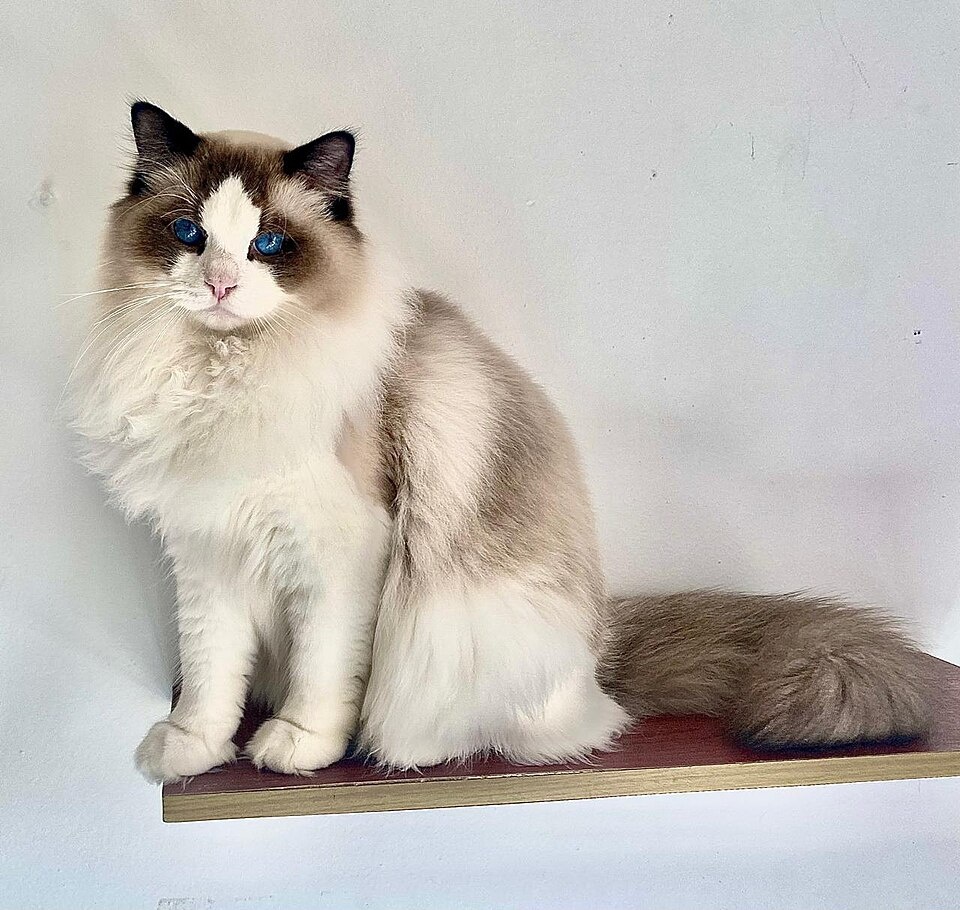
If you notice a change in the coat, self-grooming or tolerance of touch, tell a veterinarian or appropriate grooming professional what changed. A breed description cannot explain the cause.
The best part of living with a Ragdoll is discovering their own version of closeness. It may be touch, play, nearby company, or a small familiar ritual. A beautiful relationship gives that choice room to grow.
KEEP EXPLORING
Recommended stories


Research details
Mikkola and colleagues asked owners about 4,316 cats, studied seven behavior traits and compared breed groups. Who chose to take part and how owners answered limit how widely the findings apply. The handling and life-stage sources are veterinary guidelines, not trials of a household routine for Ragdolls.
The 2021 life-stage guidelines report educational grants from Boehringer Ingelheim, CareCredit, Dechra, Hill’s, IDEXX, Merck, and Zoetis. They combine research and professional guidance for cats generally, rather than testing a routine in either breed.
The 2022 interaction guidelines report no financial support for the article. Their disclosures include Ilona Rodan’s Royal Canin advisory role, Nathalie Dowgray’s part-time postdoctoral work at a Royal Canin-funded clinic, and Sam Taylor’s Linnaeus employment. The authors also disclose educational, conference, and consultancy remuneration; the guidance concerns veterinary interaction, not a tested household program.
Mikkola’s study included 4,316 cats overall; a 972-cat subset was used for one validation comparison. It reports funding from Suomen Kissaliitto, the Agria and SKK Research Fund, and the Academy of Finland. Hannes Lohi was a Petsofi cofounder and Emma Hakanen an employee during data collection; Petsofi supplied the survey platform.
Sources
-
Mikkola and colleagues. Reliability and Validity of Seven Feline Behavior and Personality Traits. Animals, 2021.
-
Rodan and colleagues. 2022 AAFP/ISFM Cat Friendly Veterinary Interaction Guidelines: Approach and Handling Techniques. Journal of Feline Medicine and Surgery, 2022.
-
Quimby and colleagues. 2021 AAHA/AAFP Feline Life Stage Guidelines. Journal of Feline Medicine and Surgery, 2021.
-
Susan Cook Henry. Tools for Your Kitten's Beauty Parlor. CFA, May 13, 2025.
-
Cat Fanciers’ Association. Most Popular Breeds for 2026. April 22, 2026. Attributed breed portraits; registration popularity is not a measure of search demand.
Photo credits
Photo: Leijurv, “Ragdoll Cat Stretching”, via Wikimedia Commons. CC BY-SA 4.0. Complete source frame retained; export metadata removed by WatersEdge. This image derivative is shared under CC BY-SA 4.0. Photo source · License

Photo: Cgomez766, “Gato Ragdoll BreedingCat”, via Wikimedia Commons. CC0. Complete source frame retained; export metadata removed by WatersEdge. Photo source · License

Photo: Cgomez766, “Gato Ragdoll Breedingcat”, via Wikimedia Commons. CC0. Complete source frame retained; export metadata removed by WatersEdge. Photo source · License

Leave a Reply