
A Better Walk Begins With the Right Question
We compared six familiar harnesses and found something more helpful than a universal winner: a thoughtful way to choose for the particular dog beside you.
everyday dog harness
We compared six familiar harnesses and found something more helpful than a universal winner: a thoughtful way to choose for the particular dog beside you.
A walk begins before the front door opens. There is the suspiciously accurate reading of the shoe rack, the sudden appearance of a tail, and the small ceremony of clipping in. A harness sits at the center of all that anticipation, which is one reason choosing one should feel more thoughtful than decoding four promises on a package.
We’ll begin with what pulling and movement studies can tell us, then explain our comparison criteria. After meeting six harnesses and their maker claims, we’ll compare the details and turn the remaining gaps into questions about your own dog’s walk.
Key sections
- The findings that change the shopping question
- How we compared the six models
- What the six brands actually claim
- What we still want to know
- What we would actually do with this
For this everyday dog harness guide, we compared six familiar models and went looking for what independent research could add. The search turned up something more useful than a winner: a better way to think about fit, movement, attachment points, and the particular dog waiting to go outside.
That is the cheerful news here. The best question is not “Which logo wins?” It is “What lets this dog move comfortably on this walk?”
No products were bought, worn, tested, or scored for this guide. Waters Edge has no commercial relationship with any manufacturer named.
Let’s begin with the dog’s fit and movement
Fit includes how the harness sits on the dog and how the dog moves while wearing it. The studies below explore parts of that question, without testing the six exact models.
Dogs pulled harder in the harness, not less
Pulling depends on the dog and the situation as well as the equipment. In a 2021 test of 52 shelter dogs, the dogs pulled harder and more steadily toward food in a back-connection harness than in a neck collar. The result disappeared when toys, rather than food, were used as the attraction. Even the dogs declined to make this a tidy answer.
That does not mean every harness makes every dog pull more. It was one controlled setting, with shelter dogs, and it did not test the exact products in this guide. It does mean a back attachment should not be assumed to reduce pulling simply because a package says “no-pull.”
The study compared pulling; it did not establish that any of the models below protects a dog’s throat. That claim needs its own evidence.
Every harness changed the way the dogs moved
Movement gives us another way to look at fit, beyond whether a harness stays on. A 2022 pilot study found that every harness tested changed some part of the dogs’ gait. It also found no design that worked best for every dog.
Only four healthy adult dogs took part, so this is an early signal, not a verdict. But it points toward a better shopping question: not “Which harness is best?” but “Which harness fits this dog, this body, and this walk?”
The criteria we used, and why
We compared what each harness is made to do with the evidence available for those promises.
Materials, adjustment points, buckles and washing instructions help you judge whether a harness could suit your dog and daily routine. Published specifications can answer many of those questions.
Promises to reduce pulling, protect the throat or keep a dog safe in a crash need more than a material list. They need testing that matches the benefit being claimed.
We keep those two kinds of information separate. Welfare benefits claimed by a manufacturer remain attributed to that manufacturer; we did not independently verify a welfare outcome for any of the six products.
We compared leash attachment points, adjustments, closures, padding, sizing, washing instructions, country of manufacture and warranty terms. For dogs who dislike having equipment passed over their heads, we also checked whether the harness opens at the neck.
The six, in their own words
Every specification below is the manufacturer’s own, from its current public product pages. We have verified that these are the published claims. We have not verified any performance or welfare outcome.

Ruffwear Front Range
Photo courtesy of Ruffwear.
Listed price: See product page for the current exact size and price.
What we like about it: The unusually specific material list gives us something tangible to appreciate. Its separate front and back attachment points are thoughtful details to compare.
Highlights about the product
- Maker lists four adjustment points and five girth sizes.
- Recycled-polyester shell and mesh lining; foam padding.
For more details,
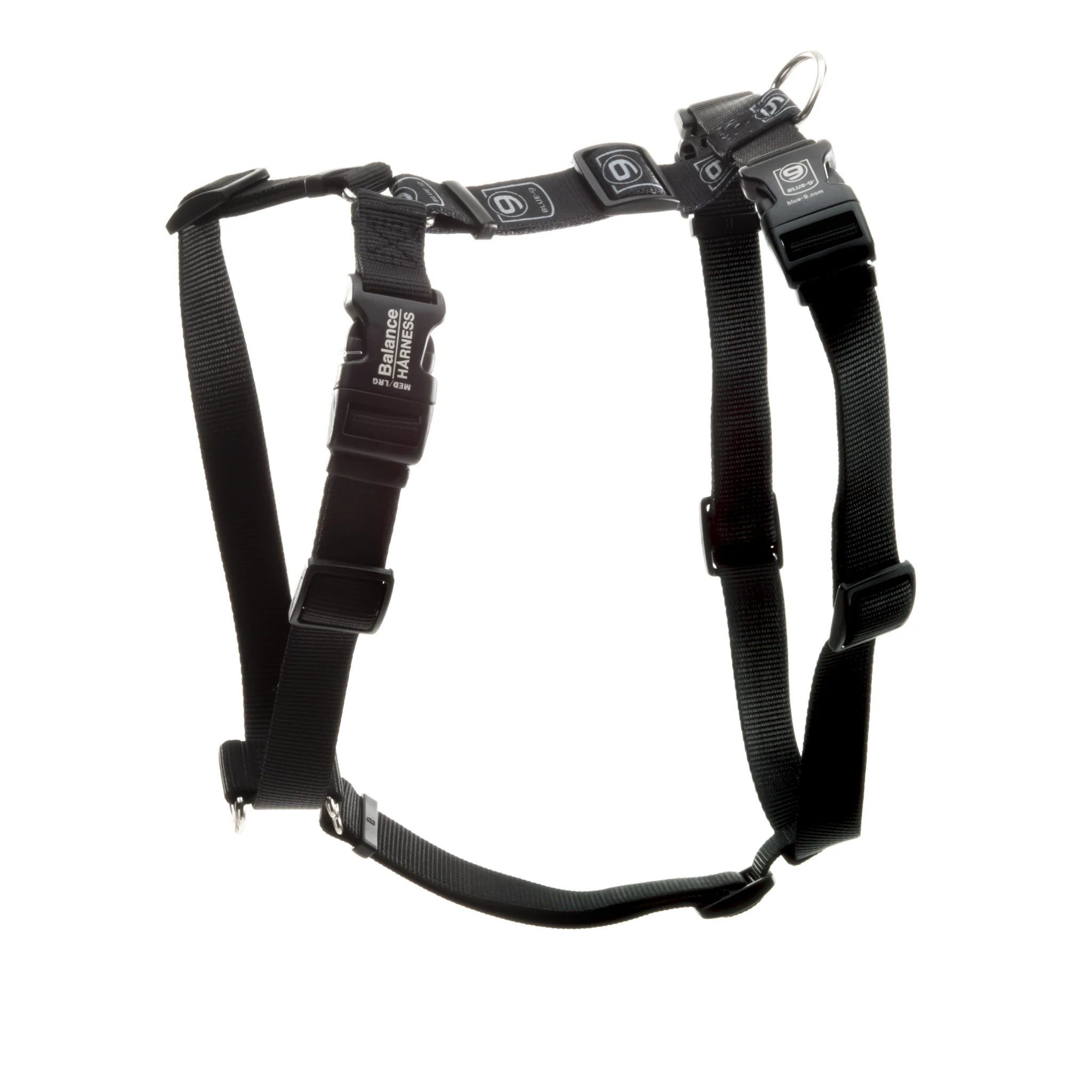
Blue-9 Balance
Photo courtesy of Blue-9 Pet Products.
Listed price: See product page for the current exact size and price.
What we like about it: Six adjustment points offer several places to alter the fit. The buckle-neck version also avoids having to pass the harness over the dog’s head.
Highlights about the product
- Maker lists front and back leash rings.
- Five sizes; buckle-neck option avoids slipping the harness over the head.
For more details,

2 Hounds Design Freedom No-Pull
Photo courtesy of 2 Hounds Design.
Listed price: See product page for the current exact size and price.
What we like about it: The velvet lining is a distinctive material detail. A separate chewing-replacement warranty acknowledges a familiar part of life with dogs.
Highlights about the product
- Maker lists four adjustment points and stainless-steel hardware.
- Front attachment and a tightening martingale loop at the back.
For more details,

PetSafe Easy Walk
Photo courtesy of PetSafe.
Listed price: See product page for the current exact size and price.
What we like about it: A sizing chart that includes chest width and girth is a useful bit of clarity. The front attachment gives this harness a visibly different construction from a back-clip design.
Highlights about the product
- Maker lists eight sizes and four adjustment points.
- Front martingale loop tightens when the dog pulls; no back attachment documented.
For more details,

Kurgo Enhanced Strength Tru-Fit
Photo courtesy of Kurgo.
Listed price: See product page for the current exact size and price.
What we like about it: Steel nesting buckles and a padded chest plate distinguish this design. Kurgo also names the versions covered by its reported crash testing, a detail worth checking before buying.
Highlights about the product
- Maker lists five adjustment points and an included vehicle tether.
- Kurgo’s reported June 2018 testing covered Enhanced Strength v.3 in Small, Medium and Large; it does not establish every current version’s performance.
For more details,

Julius-K9 IDC Powerharness
Photo courtesy of Julius-K9.
Listed price: See product page for the current exact size and price.
What we like about it: Interchangeable patches give the saddle a small personal touch. The handle and adjustable chest strap are distinctive details to examine alongside the exact size.
Highlights about the product
- Maker lists an adjustable chest strap and top handle.
- The construction differs between smaller and larger dog sizes.
For more details,
Comparison table
Claims down the left, manufacturers across the top. Each entry reflects only what that manufacturer states on its current pages.
Legend: ✓ the brand makes this claim · × the brand explicitly states it is not offered · Not established means we could not verify the information in the pages consulted.
A checkmark means the manufacturer makes the claim. It does not mean Waters Edge verified the benefit. “Not established” marks missing information, not a fault.
| Claim or feature | Ruffwear Front Range |
Blue-9 Balance |
2 Hounds Freedom |
PetSafe Easy Walk |
Kurgo Tru-Fit ES |
Julius-K9 IDC |
|---|---|---|---|---|---|---|
| Back leash attachment | ✓ aluminum V-ring | ✓ | ✓ martingale loop | Not established | Not established | ✓ |
| Front leash attachment | ✓ reinforced clip | ✓ | ✓ | ✓ only attachment | Not established | Not established |
| Stated adjustment points | 4 | 6 | 4 | 4 | 5 | Not established |
| Over-head-free closure option | Not established | ✓ buckle neck | Not established | Not established | Not established | ✓ one-click |
| Girth range stated | ✓ 13–42 in (33–107 cm) | Not established | Not established | ✓ chart | Not established | Not established |
Manufacturers publish specifications inconsistently. In the pages we consulted, some lacked a measurable chest range, washing instructions or a count of adjustment points. Those details remain unknown in this guide.
What We Still Want To Know
Whether any of the no-pull claims hold. Three of these six make a pulling claim. We found no independent test of those specific products, while the one relevant study pointed the other way for back-connection designs. That leaves a surprising hole at the center of the category.
What harnesses do to gait over years. The pilot gait study lasted a treadmill session and involved four dogs. It cannot tell us what daily wear means for a growing dog, an arthritic dog, or a dog using the same design for a decade.
Whether crash-test claims transfer between versions. Kurgo’s documented testing names v.3. We could not establish from the pages consulted whether current retail stock is that version.
Breed and body shape. None of the research we found addressed deep-chested, barrel-chested or short-muzzled dogs specifically.
Cats. Harness use in cats is a genuinely different problem and nothing here applies to it.
What we would actually do with this
The research points toward a practical conclusion, not a product: fit and the individual dog matter more than the brand.
Questions worth carrying into the decision:
- What is the actual walk? A neighborhood loop, a muddy trail, and a dog who hates things going over their head produce different answers. Two of these six address the over-the-head problem directly.
- Front connection, back connection, or both? If the goal is less pulling, the Shih study is reason to be skeptical of a back-only design being sold on that promise.
- Does the size chart match measurements you have actually taken? Ruffwear and PetSafe publish measurement-based charts. Several others do not.
- If vehicle safety matters, which version was tested?
- Can you clean and dry it in the space you have? Check the exact model’s care instructions before buying.
- Does the exact model have fitting instructions? Blue-9’s Balance instructions were the most detailed we found; each harness should be assessed using its own manufacturer’s guidance.
If your dog has a bone or joint condition, walks differently or seems sore when moving, ask the veterinary team about harness fit. A buying guide cannot assess those problems for your dog.
This is where we would like the Pack’s help.
If you have walked the same dog in both front- and back-connection harnesses, what changed? Did the dog pull differently, move differently or seem more comfortable? Those observations cannot prove that a design works for all dogs, but they can point us toward questions worth investigating.
And if you are a veterinary physiotherapist or rehab practitioner who works with dogs affected by poor harness fit, we would like to hear what you see most often in real dogs, day after day.
How this guide was made
Specifications were taken from each manufacturer’s public product pages on September 18, 2026, and reflect claims published on that date. Specifications change without notice; confirm current measurements and instructions at the source before buying.
No products were purchased, tested, worn or scored. No customer ratings or review scores were used. No ranking, winner or recommendation is offered. Waters Edge holds no commercial relationship with any manufacturer named, and no affiliate arrangement applies to this article.
Research details
- Leash tension: The 2021 study used 52 shelter dogs, each tested in a neck collar and back-connection chest harness. Food and toys were used as attractions. The pulling difference appeared in the food condition, not the toy condition.
- Gait: The 2022 pilot used four healthy adult dogs of different breeds and sizes on a treadmill. Researchers compared unleashed movement with four harness conditions using motion capture. The small sample and marker-placement problems sharply limit generalization.
- Product claims: Specifications were recorded from manufacturer pages on September 18, 2026. No independent product testing was performed.
Sources
Blue-9 Pet Products. “Balance Harness , Six-Point Adjustable Dog Harness.” Manufacturer product page. Consulted 18 September 2026. https://www.blue-9.com/products/bhb
Blue-9 Pet Products. “How to Fit the Balance Harness.” Manufacturer fitting guidance. Consulted 18 September 2026. https://www.blue-9.com/pages/balance-harness-fitting
Julius-K9. “IDC Powerharness.” Manufacturer product page. Consulted 18 September 2026. https://julius-k9.com/idc-powerharness/
Kurgo. “Dog Harness Crash Testing Methodology.” Manufacturer page. Consulted 18 September 2026. https://www.kurgo.com/dog-harness-crash-testing-methodology
Kurgo. “Enhanced Strength Tru-Fit Smart Harness.” Manufacturer product page. Consulted 18 September 2026. https://www.kurgo.com/enhanced-strength-tru-fit-smart-harness/
Pálya, Zsófia, Kristóf Rácz, Gergely Nagymáté, and Rita M. Kiss. “Development of a detailed canine gait analysis method for evaluating harnesses: A pilot study.” PLOS ONE. 9 March 2022. https://journals.plos.org/plosone/article?id=10.1371/journal.pone.0264299
PetSafe. “Easy Walk Harness, No Pull Dog Harness.” Manufacturer product page. Consulted 18 September 2026. https://www.petsafe.com/product/easy-walk-harness/
Ruffwear. “Front Range Harness.” Manufacturer product page. Consulted 18 September 2026. https://ruffwear.com/products/front-range-harness
Shih, Phillips, Mills, Yang, Georgiou, and Paterson. “Dog Pulling on the Leash: Effects of Restraint by a Neck Collar vs. a Chest Harness.” Frontiers in Veterinary Science. 6 September 2021. https://www.frontiersin.org/articles/10.3389/fvets.2021.735680/full
2 Hounds Design. “Freedom No-Pull Harness” product and warranty pages. Manufacturer pages. Consulted 18 September 2026. https://2houndsdesign.com/collections/freedom-no-pull-harness
Leave a Reply