

Bullmastiff and English Mastiff: Making Room for the Difference
Bullmastiff vs English Mastiff
Two substantial companions, distinct histories, and a comparison best made at adult size.
There is much to admire in these substantial companions, and much to imagine about sharing a home with one. The English Mastiff is generally larger; the Bullmastiff is a separate breed with Mastiff and Bulldog ancestry. Their names are related, but they are not two sizes of the same dog.
The useful comparison goes beyond which looks grander. Think about each dog’s adult size, behavior, health records and ability to move through your home. That makes life with these lovely, substantial companions easier to picture. Smaller here is still a considerable amount of dog.
We’ll begin with the two breeds’ histories and outlines, then put adult size into the rooms, car and routines of a real home. We’ll also look at individual behavior, everyday care, feeding and the health records that belong to the actual breed and family.
A NOTE FROM WATERSEDGE
We read the research, we talk to people who do this work, and we try to make complicated animal-health information easier to understand. What you're reading reflects how we've interpreted and organized what we found. It is educational, not veterinary advice, a diagnosis, or a treatment plan for your animal.
We're not perfect, and neither is the available research. Evidence changes, new work gets published, and what suits one animal may be wrong for another. Species, breed, age, weight and existing conditions all change the answer.
Use this as a starting point for your own reading and for the conversation with your veterinarian, particularly if your animal is on medication, is under treatment, has an existing condition, is pregnant, very young or very old, or if anything about their condition is changing quickly.
01 / Let’s begin with two names and two histories
Let’s begin with two names and two histories
Those related names can be confusing, so let’s begin with the breeds they identify. In Stephanie Gibeault’s 2020 American Kennel Club (AKC) comparison, the Bullmastiff’s nineteenth-century development involved Mastiff and Bulldog ancestry for gamekeepers. A modern cross of those breeds is not automatically a registered Bullmastiff.
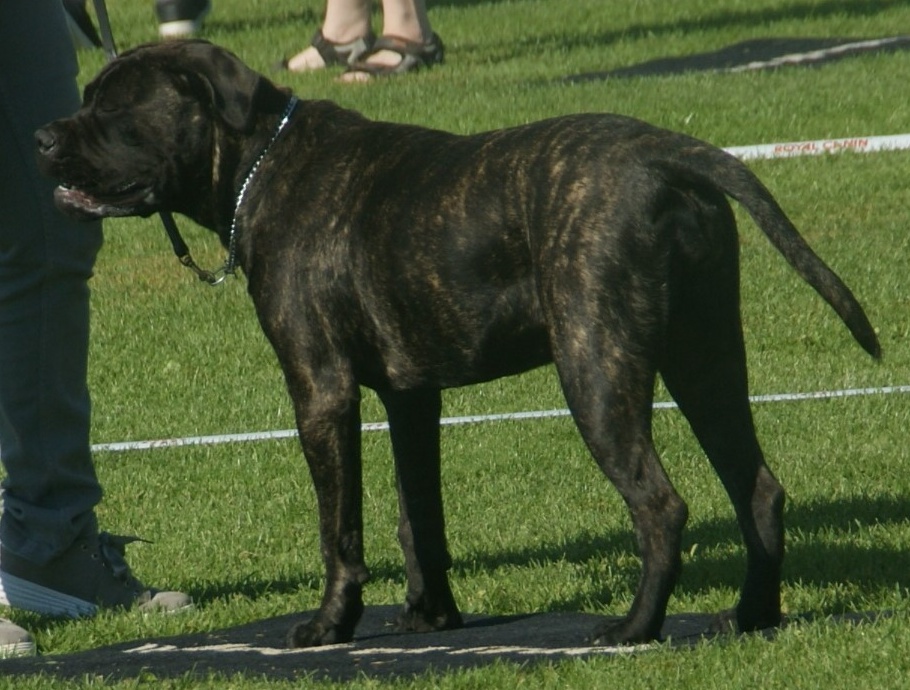
Here, English Mastiff means the breed AKC registers as Mastiff. The word mastiff can describe a broader type, so check the actual registered breed when reading listings or health information. Resemblance alone cannot establish pedigree.
Gibeault’s named breed practitioners also describe different outlines: the Bullmastiff nearly square, the Mastiff more rectangular. Those proportions help you appreciate breed form; they cannot establish health from a photograph.
02 / How much bigger are we talking?
How much bigger are we talking?
Now let’s give “large” a little more meaning, while remembering that these figures describe breeds rather than setting a target for a dog. Gibeault’s report gives Bullmastiff ranges of 110–130 pounds for males and 100–120 for females. In the same report, breeder-judge Mary Lynn Speer describes most male Mastiffs as 170–200 pounds and females as 150–180.
Those are attributed breed descriptions, not measurements of every dog or feeding targets. Reaching the upper number does not prove better condition.
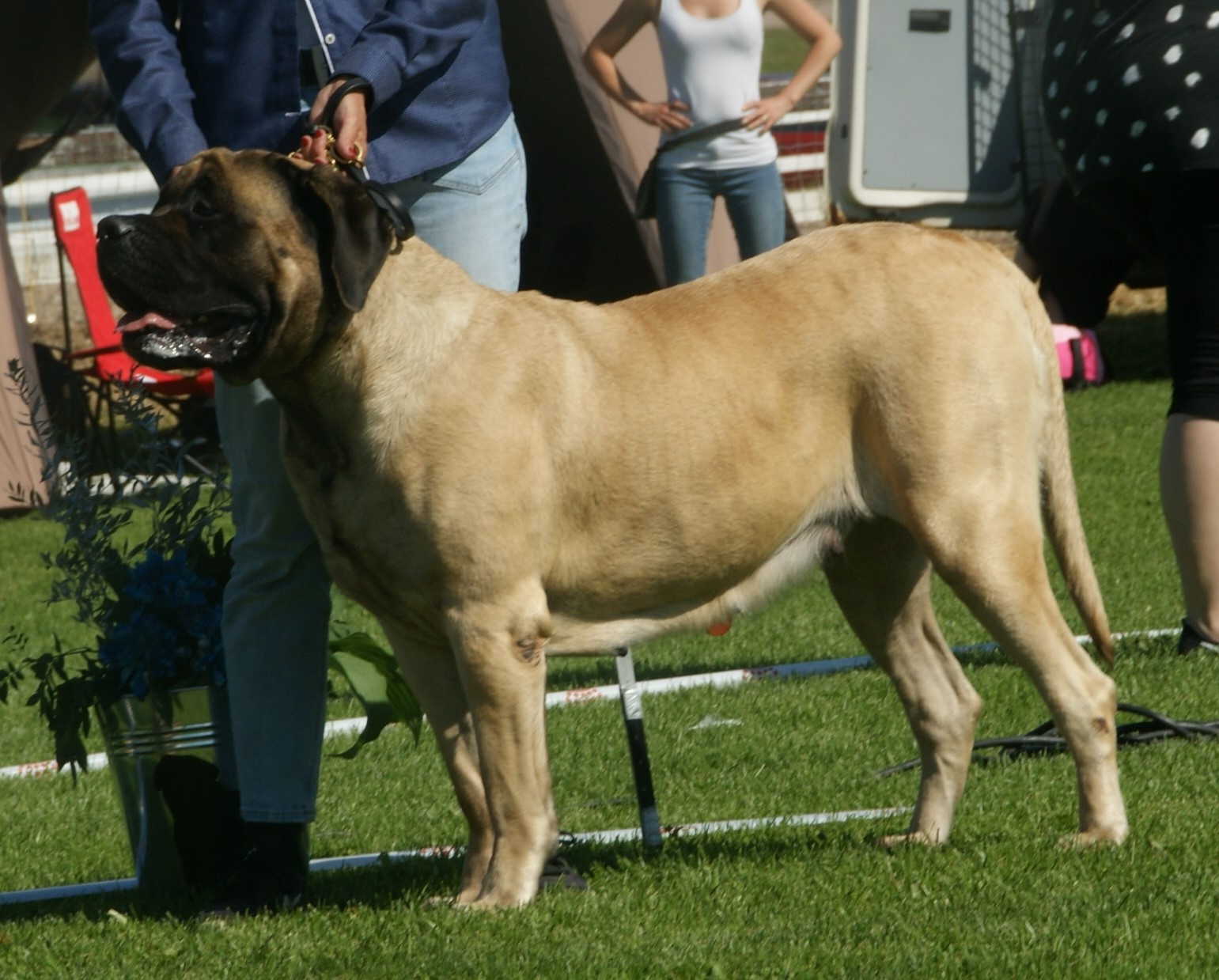
Meeting adult relatives makes the difference more tangible than a puppy photo. Consider:
- Sleeping space and clear passage through doors and hallways.
- Vehicle space and the route in and out.
- Steps and other access if movement becomes difficult.
- The people and help available if an adult cannot move comfortably.
Planning for illness or aging is a quiet expression of affection. It gives the future adult a place in your thinking before help is needed.
03 / Get to know the individual dog
Get to know the individual dog
Size helps us plan the space; getting to know the individual helps us picture the company. Gibeault’s practitioners describe Mastiffs as more laid-back and less agile than Bullmastiffs and discuss guarding heritage in both. These are experience-based accounts, not measured predictions of a particular dog’s behavior or safety with visitors.
“Protective” deserves particular care. A historical role does not establish that a household dog will reliably distinguish a welcomed guest from danger. Threatening behavior should not be excused by the label, and no one needs to stage an intrusion to test it.
Ask about existing observations: visitors, handling, other animals, unfamiliar environments, and settling after activity. For an adult placement, discuss known incidents and current support. For a puppy, the parents’ behavior provides background, not a promise.
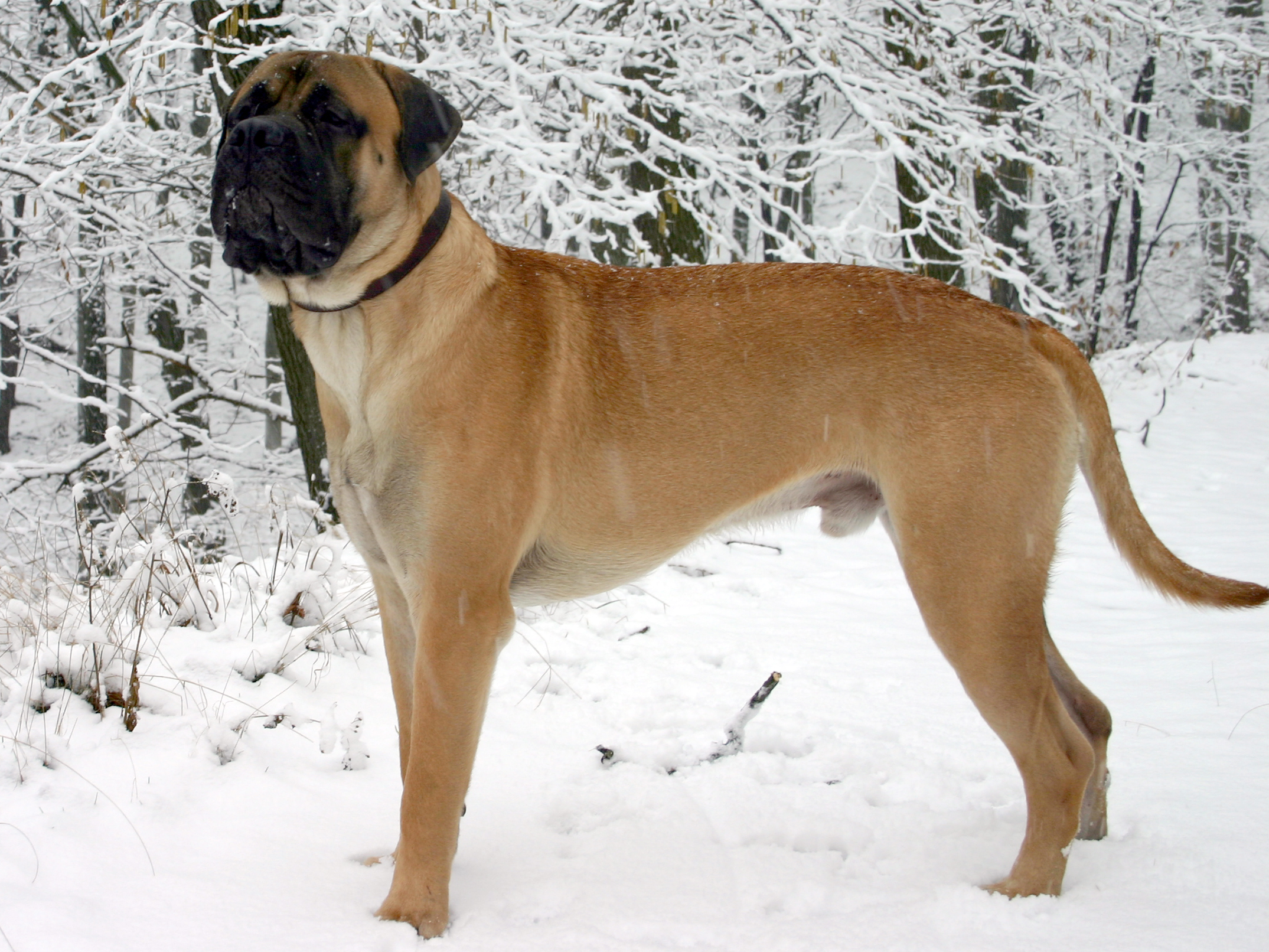
Proportions matter for equipment, too. Similar weights do not guarantee the same harness fit or bed space. The body using the item deserves more attention than the number on a size chart.
04 / Care at this scale
Care at this scale
A short coat is only one part of the commitment. Skin, nails, ears, teeth, and general veterinary care remain, alongside the practical ability to manage visitors or separate household animals when needed.
Measure the vehicle opening and the space where the adult dog will turn and rest, rather than relying on a puppy-sized visit. Ask a caregiver how their dog manages ordinary transfers and appointments. If lifting or access may be difficult, discuss a suitable arrangement with the veterinary team before the situation becomes urgent.
Sherry Sanderson’s veterinary nutrition review explains that energy needs do not rise directly pound for pound with body weight. Life stage, activity, and the individual matter. A dog weighing twice as much does not necessarily need twice as much food.
For a useful feeding conversation, bring the food label, its calorie information, the age group it is intended for, the amount the dog eats and records of weight or body changes. Keep puppy growth separate from adult maintenance.
Health screening belongs with the actual breed and named parents, not one universal mastiff list. Maharaj’s AKC health-testing reporting separates parental screening from the puppy’s examination. Neither is a lifetime guarantee.
Compare two real adult dogs or programs against the life you can offer: size, ordinary behavior, care records, and handling arrangements. Which part of adult-sized life together feels ready, and which would benefit from seeing it in person?
Research details
This comparison uses Stephanie Gibeault’s original July 2020 AKC reporting of observations from Sherry Boldt, Mary Lynn Speer, and Diane Collings. Numeric ranges and body outlines are attributed to that report, not presented as a newly issued Bullmastiff standard. No controlled temperament or household-suitability comparison was performed. Sanderson’s reviewed nutrition account explains general principles rather than a comparison trial in these breeds.
Sources
-
Gibeault, Stephanie. “Mastiff vs. Bullmastiff: How to Tell the Difference.” American Kennel Club, July 15, 2020. Reporting with Sherry Boldt, Mary Lynn Speer, and Diane Collings.
-
Sanderson, Sherry Lynn. “Nutritional Requirements of Small Animals.” Merck Veterinary Manual. Full review November 2023; updated September 2024; peer reviewed by Elizabeth Prouty. Veterinary nutrition review.
-
Maharaj, Nandini. “What Is Health Testing for Dogs?” American Kennel Club, June 6, 2024. Breeding screening and puppy examinations.
KEEP EXPLORING
Recommended stories


Photo credits
Photo: Corpusdigitalis (FHvB), CC BY-SA 2.0 DE, Bullmastiff Junghund 1 Jahr.jpg, via Wikimedia Commons. Any published crop must be identified; share-alike applies to adapted Junghund image. Photo source · License

Photo: Canarian, via Wikimedia Commons. CC BY-SA 4.0. Cropped by WatersEdge; derivative shared under CC BY-SA 4.0. Photo source · License

Photograph: Canarian / Wikimedia Commons, CC BY-SA 4.0. Full frame; JPEG re-encoded. Photo source · License

Featured photograph: Canarian. Photo source. CC BY-SA 4.0. Whole source frame proportionally resized.
Leave a Reply