

A Reactive Dog’s Walk: Understand the Whole Encounter
What makes a dog bark or lunge on a walk? Understanding the encounter helps explain their need for space and support.

A walk should have room for the good things: interesting smells, familiar company and a dog enjoying the world. Barking or lunging can make those pleasures harder to reach for the animal and the person holding the leash.
At WatersEdge, we found that “reactive” describes a strong response, not a single explanation. Fear, frustration, learning and physical comfort can contribute in different ways.
We’ll begin by asking what your dog may be responding to, then look at the difference space can make and why silence is not the only sign of progress. Along the way, we’ll gather the details that help a qualified professional understand the whole encounter.
A NOTE FROM WATERSEDGE
We read the research, we talk to people who do this work, and we try to make complicated animal-health information easier to understand. What you're reading reflects how we've interpreted and organized what we found. It is educational. It is not veterinary advice, a diagnosis, or a treatment plan for your animal.
We're not perfect, and neither is the available research. Evidence changes, new work gets published, and what suits one animal may be wrong for another. Species, breed, age, weight and existing conditions all change the answer.
Use this as a starting point for your own reading and for the conversation with your veterinarian, particularly if your animal is on medication, is under treatment, has an existing condition, is pregnant, very young or very old, or if anything about their condition is changing quickly.
01 / Let’s start with what the dog is responding to
Let’s start with what the dog is responding to
To understand a difficult walk, let’s first leave room for more than one explanation. One dog may want an approaching animal to go away. Another may be frustrated because it cannot reach something interesting. The same loud response does not establish the same feeling.
McPeake and colleagues studied how dogs reacted when they could not get something they expected or wanted. Some of those reactions matched owners’ questionnaire reports of frustration, but the pattern varied between tests. The study cannot diagnose why a particular dog barks or lunges on a leash.
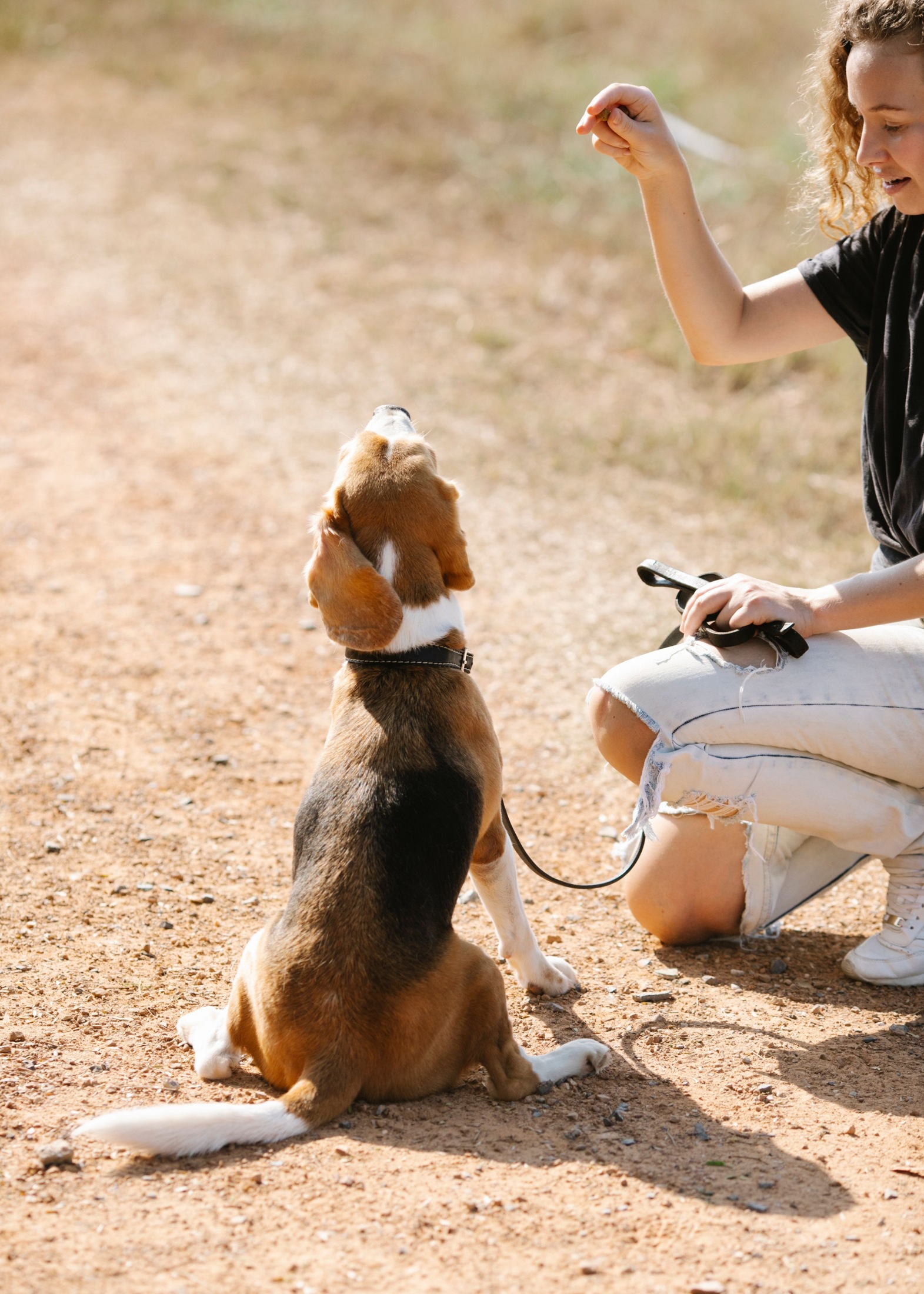
Instead of assuming why a dog reacts, describe what happened before, during and after the encounter.
02 / Space changes the situation
Space changes the situation
Next, let’s picture the space around that encounter. A dog approaching on a narrow sidewalk is different from one passing across a field. Distance, direction, speed and routes away all affect the encounter.
Choose a route with room to turn away, and have a simple phrase ready for other walkers: “We need a little space, thank you.” A courteous request does not require a sidewalk explanation of the dog’s history. Ask your behavior professional how to handle the narrow spots you cannot avoid.
According to the Merck Veterinary Manual, behavior treatment may use gradual exposure the dog can cope with and pair it with something pleasant. These methods are called desensitization and counterconditioning. A professional can help plan how to make the encounter easier and change what the dog expects from it.
A professional needs the actual dog’s response to set that plan. There is no distance or pace that works for every animal.
03 / Quiet is not the only goal
Quiet is not the only goal
As we consider progress, it helps to ask how the dog feels as well as what we hear. A dog becoming silent does not prove that the encounter feels comfortable or safe. The American Veterinary Society of Animal Behavior (AVSAB) favors reward-based methods and does not consider methods that use pain, fear or intimidation necessary for behavior treatment.

Pain, intimidation or a correction can add another unpleasant event to a difficult encounter. Suppressing a bark is not the same thing as understanding what the dog needs.
Health changes matter too. Tell the veterinary team if your dog is slower to rise, moves differently or finds harness handling difficult. Those observations may help an assessment, but they do not diagnose pain at home.
04 / Make the next conversation specific
Make the next conversation specific
For the next professional conversation, a clear account can be more helpful than the label “reactive.” Record naturally occurring encounters without staging them:
- What appeared and roughly how far away it was.
- Its direction and speed.
- The dog’s first response and what happened afterward.
- How soon the dog returns to sniffing, walking or settling afterward.
- Recent health, movement or handling changes.
Ask a qualified professional how the plan will keep everyone safe now, investigate the dog’s response and help the dog learn at a manageable pace. If there has been contact, injury or escalating risk, make that clear when seeking help.
A worthwhile walk does not require greeting everyone. It can mean a dog noticing something, gaining space and returning to the splendid business of sniffing. That is a useful goal to discuss, rather than making silence the whole measure of progress.
KEEP EXPLORING
Recommended stories


Research details
McPeake’s study compared owners’ frustration-questionnaire answers with observed behavior; it did not test leash-reactivity treatment. The link with repeated lunging came from only part of the sample, and stress-hormone analyses used a smaller group. China’s three-group study examined recall training and training tasks, using different trainers in different seasons. Those differences limit what we can conclude about cause and effect. McPeake and colleagues declared no external funding or conflicts of interest. China’s work drew on a DEFRA-funded project and a University of Lincoln bursary. The learning examples in this article are explanations, not observed cases or diagnoses. No exposure distance, device, medicine or individual training plan is prescribed.
Sources
-
Borns-Weil S. “Behavior Problems of Dogs.” Merck Veterinary Manual, professional version; full review September 2025. Peer reviewed by Carlo Siracusa. Read source.
-
McPeake KJ, Collins LM, Zulch H, Mills DS. “Behavioural and Physiological Correlates of the Canine Frustration Questionnaire.” Animals, 2021. Read paper.
- Merck Veterinary Manual. “Treatment of Behavior Problems in Animals.” Full review September 2024; updated September 2025. Read source.
- AVSAB. “Position Statement on Humane Dog Training.” 2021. Read statement.
- China L, Mills DS, Cooper JJ. “Efficacy of Dog Training With and Without Remote Electronic Collars vs. a Focus on Positive Reinforcement.” Frontiers in Veterinary Science, 2020. Read paper.
- AAHA. “Guiding Principles of Pain Assessment.” 2022. Read source.
Photo credits
- Lead photograph: Takashiba at English Wikipedia / Wikimedia Commons. Original photograph · Public domain. A Shiba Inu standing on grass with its tail curled over its back. Illustrative photograph.
- Supporting photograph: Blue Bird / Pexels. Original photograph · Pexels free license. A Beagle sitting beside a person holding a treat on a country path. Illustrative photograph. Crop made from original.
- Additional photograph: cri_supe / Wikimedia Commons. Original photograph · Public domain. A Basenji standing on grass with its tail curled upward. Illustrative photograph.


Featured photograph: Pleple2000. Photo source. CC BY-SA 3.0. Whole source frame proportionally resized.

Leave a Reply