

When Your Dog Guards Something Precious
A safer conversation starts with what happens around the valued thing.

A dog’s treasure can be wonderfully ordinary: dinner, a chew, a bed or something discovered under the furniture. When someone approaching it creates tension, the moment deserves care rather than a contest over who is in charge.
At WatersEdge, we found that guarding can begin before a growl. Quiet movements and the context around them belong in the explanation too.
In this article, we’ll look at the quieter signs of guarding, why taking things away can make matters worse, and how to describe the risks in your household. We’ll also consider when pain or surprise may be part of what happened.
A NOTE FROM WATERSEDGE
We read the research, we talk to people who do this work, and we try to make complicated animal-health information easier to understand. What you're reading reflects how we've interpreted and organized what we found. It is educational. It is not veterinary advice, a diagnosis, or a treatment plan for your animal.
We're not perfect, and neither is the available research. Evidence changes, new work gets published, and what suits one animal may be wrong for another. Species, breed, age, weight and existing conditions all change the answer.
Use this as a starting point for your own reading and for the conversation with your veterinarian, particularly if your animal is on medication, is under treatment, has an existing condition, is pregnant, very young or very old, or if anything about their condition is changing quickly.
01 / Let’s start with the signs that are easy to miss
Let’s start with the signs that are easy to miss
As we look at guarding, it helps to know that the first signs are not always easy to recognize. According to the Merck Veterinary Manual, dogs may try to keep a valued object or place by:
- Carrying an item away.
- Putting their body between it and someone approaching.
- Eating faster or becoming still.
- Growling, snapping or biting.
The absence of a growl does not mean taking the object is safe. Note the item, who approached and what the dog did, using what has already happened rather than testing the response again.
A behavior does not reveal the dog’s entire history. Learning, temperament, context and other contributors may all matter.
02 / Reassurance is not forced removal
Reassurance is not forced removal
To understand why forced removal may be unsettling, consider what the dog learns from an approach. If it repeatedly predicts losing something valuable, that experience can influence the dog’s response. It is not proof that every guarding dog has been treated badly.
Merck warns that confrontation can undermine trust and escalate anxiety or aggression. Repeatedly removing a bowl to prove possession is not a simple recipe for reassurance.
A qualified professional may teach the dog to release an object and help them become less worried when someone approaches. These are different goals; getting the object back once does not show that the dog is comfortable with the approach. The professional needs to assess the risk before planning that work.
03 / Protect the household first
Protect the household first
While that behavior is being assessed, the household needs an arrangement that prevents risky encounters. Children and visitors should not carry responsibility for noticing a subtle warning at exactly the right moment. A dog may also guard food or belongings from another dog.
The practical conversation can be very specific: can the dog eat in a separate room behind a closed door, and who will keep children and other animals away? Agree the arrangement with the professional helping you. Everyone in the household needs the same instructions before a meal or valued chew appears.

A second bowl or toy is not automatically an answer if an animal still faces an unwanted approach on the way to it. Guarding toward people and toward dogs need separate descriptions.
Ask the professional how the immediate arrangement will prevent risky encounters: where valued items are used, which separation is needed and who is responsible. If a dangerous object is involved, seek appropriate instructions rather than attempting a contest over it.
04 / Could pain or surprise be involved?
Could pain or surprise be involved?
A dog who reacts when touched or moved from a resting place may be in pain or may have been startled. The reaction is not necessarily guarding. Tell the veterinarian about any new difficulty moving or being handled.
Gather details already available:
- The objects or places involved.
- Who approached and what the dog did first.
- Any contact, injury or escalation.
- When the pattern began.
- Changes in health, movement or handling.
Do not recreate the scene or ask someone to test the dog for video. Seek veterinary and appropriately qualified behavior support with a clear account of the risk.
The takeaway is a plan that protects people and animals while investigating what the dog experiences. Understanding and safety belong together. Neither requires proving a point over the food bowl.
KEEP EXPLORING
Recommended stories


Research details
Vieira de Castro’s 2020 study compares dogs attending schools with different training methods; group selection was not randomized, and the study does not test resource-guarding treatment. The September 2025 Merck professional review supplies the current clinical explanation of guarding, conflict, and learning. Learning sequences are explicitly hypothetical explanations. Vieira de Castro and colleagues reported FCT and UFAW funding, no funder role in the study, and no competing interests. This article supplies no home exposure, exchange, or bite-risk protocol. Clinical assessment distinguishes item guarding from pain, startle, and other situations.
Sources
- Borns-Weil S. “Behavior Problems of Dogs.” Merck Veterinary Manual, professional version; full review September 2025. Peer reviewed by Carlo Siracusa. Read source.
- Vieira de Castro AC and colleagues. “Does training method matter? Evidence for the negative impact of aversive-based methods on companion dog welfare.” PLOS ONE, December 16, 2020. Read paper.
-
AVSAB. “Position Statement on Humane Dog Training.” 2021. Read statement.
-
AAHA. “Guiding Principles of Pain Assessment.” 2022. Read source.
Photo credits
- Lead photograph: FriendlyToaster / Wikimedia Commons. Original photograph · CC BY 4.0. A Bernese Mountain Dog standing on grass in a leafy garden. Illustrative photograph. Crop made from original.
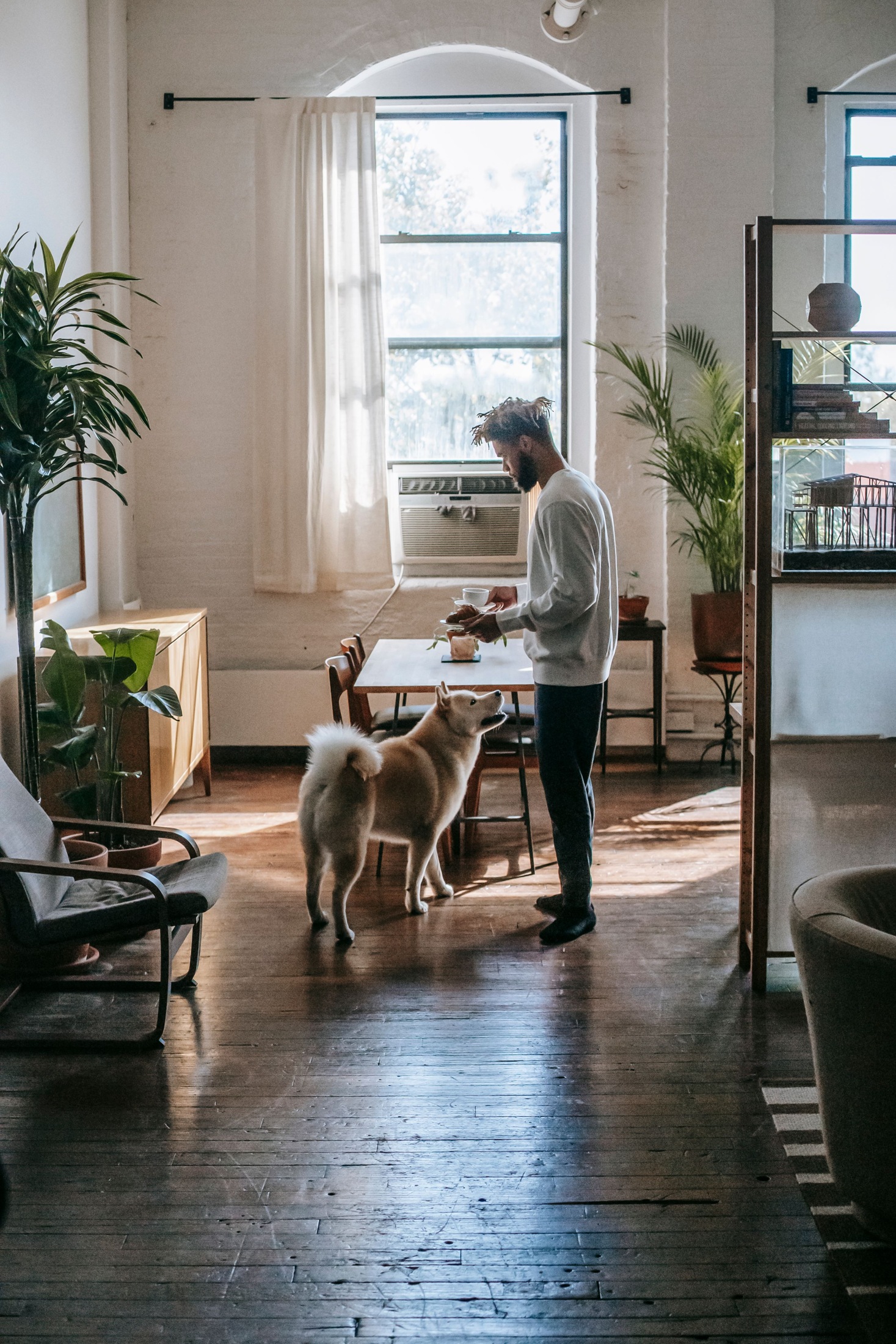
- Supporting photograph: Zen Chung / Pexels. Original photograph · Pexels free license. An Akita beside a person and a table in a sunlit room. Illustrative photograph.
- Additional photograph: Canarian / Wikimedia Commons. Original photograph · CC BY-SA 4.0. A Whippet standing outdoors with a handler. Illustrative photograph.


Featured photograph: Netbios. Photo source. CC0. Whole source frame proportionally resized.

Leave a Reply