

The Comb That Tells You What the Brush Missed
Five finishing combs differ in tooth spacing, length and grip. We compare what their makers document and explain what remains untested.

A simple comb rewards a closer look: the spacing of its teeth, the length of its reach and the place your hand rests. Let’s explore five designs with the dog’s actual coat in mind, and enjoy discovering how much can differ in such a small tool.
We’ll begin with tooth spacing, then visit five combs. Next, we’ll compare spacing labels, grips and rotating pins before gathering the measurements in a table and considering what a grooming trial would still need to show.
We looked at five exact combs: Chris Christensen Buttercombs #000, #005 and #003, its Competition Comb #508, and Artero Tango P942. The Buttercombs disclose numerical spacing, the #508 adds measurement markings, and Tango uses a bamboo handle with short and long rotating pins. The makers’ specifications explain these design differences. They do not show that one comb works better on every coat.
Small changes in the teeth and handle can make similar-looking combs quite different objects.
A Bernese Mountain Dog standing on grass in a leafy garden.
Let’s start with the space between the teeth
The spaces are one of the clearest differences to notice before considering a model. Spacing tells you how closely the teeth sit together. It helps distinguish combs, but does not establish whether a particular one suits your dog’s coat.
A comb is a wonderfully economical object. The spine, teeth and their junction do almost all the work, which makes the details unusually important.
We examined tooth arrangement, material, overall format, maker-stated use and current pricing where established. This is a construction comparison for coat maintenance and finishing, not a claim that any tool can safely resolve every knot. We did not perform comparative grooming or breakage testing.
The published measurements let us compare the designs. They cannot prove that one comb will glide through every coat or never catch a hair.

Chris Christensen Buttercomb #000: two spacings, one spine
Listed price: USD 42.00 for one comb. Chris Christensen
What we like about it: The #000 has a coarse section with eight teeth per inch and a fine section with eleven. We like being able to compare actual spacing rather than relying on “fine” and “coarse” alone.
Highlights about the product
- Chris Christensen lists scissored breeds, setters and spaniels.
- Tooth / pin arrangement: Fine and coarse fixed zones
- Published spacing: 8 coarse / 11 fine teeth per inch
For more details,

Artero Tango: a handled alternative
Listed price: USD 15.44 for P942. Artero
What we like about it: Tango has a separate bamboo handle and a mix of short and long rotating pins. You hold it differently from the metal-spine combs in this guide.
Highlights about the product
- Tooth / pin arrangement: Short and long rotating pins
- Published spacing: Numerical density unresolved
- Published tooth length: Short/long arrangement; lengths unresolved
For more details,
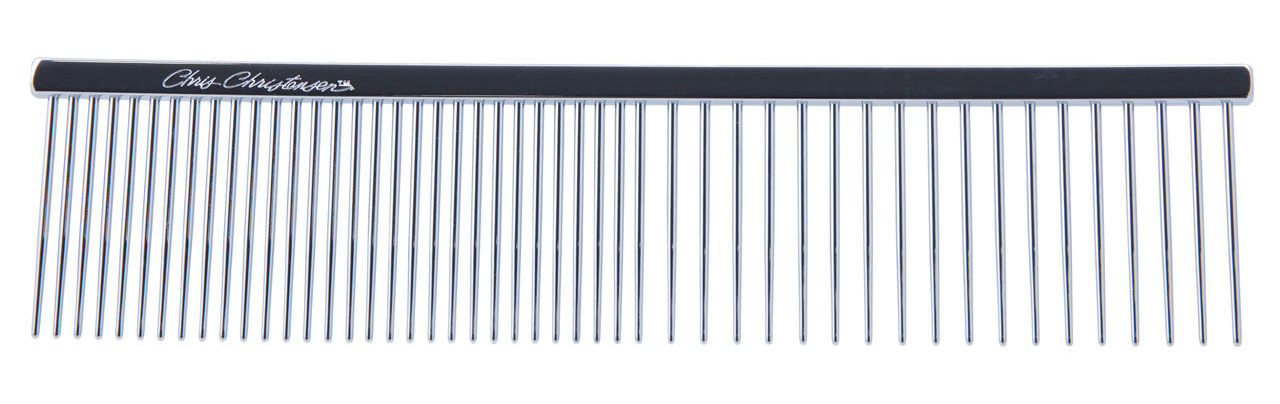
Chris Christensen Buttercomb #005: a longer tooth field
Listed price: USD 62.00 for one comb. Chris Christensen
What we like about it: The #005 has longer teeth than #000, with five teeth per inch in the coarse section and eight in the fine section. Both combs have the same spine length, so overall length alone would miss those differences.
Highlights about the product
- Chris Christensen lists double coats.
- Tooth / pin arrangement: Fine and coarse fixed zones
- Published spacing: 5 coarse / 8 fine teeth per inch
For more details,

Chris Christensen Buttercomb #003: a wider coarse section without the #005’s reach
Listed price: USD 42.00 for one comb. Chris Christensen
What we like about it: The #003 combines an extra-coarse section of three teeth per inch with a fine section of eleven, matching #000’s fine spacing. Its teeth are shorter than #005’s, so wider spacing does not mean greater reach.
Highlights about the product
- Tooth / pin arrangement: Fine and extra-coarse fixed zones
- Published spacing: 3 extra-coarse / 11 fine teeth per inch
- Published tooth length: 1¹⁄₁₆ inches
For more details,

Chris Christensen Competition Comb #508: the spine becomes a measuring reference
Listed price: USD 35.00 for one comb. Chris Christensen
What we like about it: The measuring marks give #508’s spine another purpose, and its supplied case has an obvious place in a grooming kit. These small additions give a familiar comb a character of its own.
Highlights about the product
- Tooth / pin arrangement: Medium/coarse, according to model title
- Published spacing: Numerical density unresolved
- Published tooth length: Not resolved here
For more details,
Are two combs labeled “fine” necessarily the same spacing?
The same descriptive word can hide a different measurement. Chris Christensen specifies eleven teeth per inch for the fine zones of #000 and #003, but eight per inch for #005’s fine zone. A descriptive word cannot replace the exact model’s measurement. Tango’s rotating-pin density and #508’s numerical spacing remain unresolved in the inspected records.
Check the measurements rather than relying on “fine” or “coarse.” Tooth length tells you about reach, spacing tells you how closely the teeth sit, and a separate handle changes where you hold the tool.
How do the Buttercomb and Tango grips differ?
Beyond the teeth, the place your hand rests changes the object. The manufacturers’ construction records for these dog grooming combs show a handle-free metal spine on Buttercomb #000 and a separate bamboo handle on Tango P942. The layout alone does not establish an ergonomic advantage.
With the #000, you hold the metal spine behind the fixed teeth. Tango gives you a separate bamboo handle behind its rotating pins.
On either design, inspect where the teeth join the spine; on Tango, the handle connection is another point to check. The different grips do not by themselves prove that one is more comfortable or less tiring to use.
Do rotating pins establish less pulling or breakage?
Rotating pins give us one more design feature to understand separately from its possible benefits. Artero confirms that the pins rotate. To know whether that reduces pulling or hair breakage, we would need to compare the combs on the same kinds of coat.
A comb’s finish is appealing because it is so close to the coat. The shape of the tip, the surface and the junction with the spine deserve careful attention.
Rounded tips and a polished finish are design details, rather than proof that a comb cannot snag hair or irritate skin. We would need a comparison on the relevant coat to know how each tool performs.
The same limit applies to rotating pins: we can confirm that they rotate without knowing whether they pull less on a particular dog’s coat.
The exact formats compared
How to read the comparison: Unless a study or institutional finding is identified, product descriptions come from the named manufacturers’ records. A listed feature does not establish a health, safety or performance benefit. An unresolved entry means we could not verify the information, not that the product lacks it.
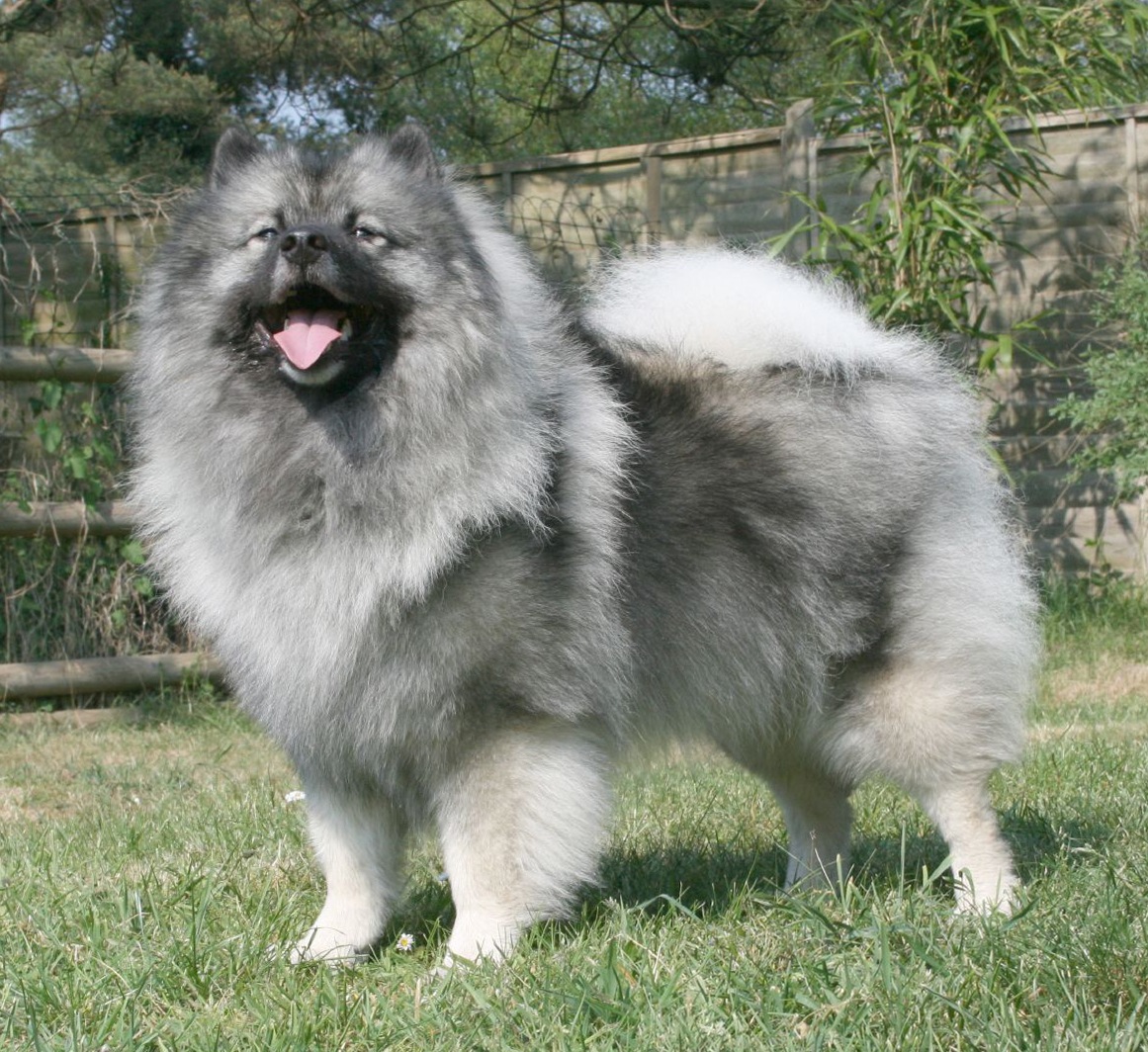
A Keeshond standing on grass with a curled, plumed tail.
| Documented detail | Buttercomb #000 |
Tango Double Rotating Pin P942 |
Buttercomb #005 |
Buttercomb #003 |
Competition Comb #508 |
|---|---|---|---|---|---|
| Tooth / pin arrangement | Fine and coarse fixed zones | Short and long rotating pins | Fine and coarse fixed zones | Fine and extra-coarse fixed zones | Medium/coarse, according to model title |
| Published spacing | 8 coarse / 11 fine teeth per inch | Numerical density unresolved | 5 coarse / 8 fine teeth per inch | 3 extra-coarse / 11 fine teeth per inch | Numerical density unresolved |
| Published tooth length | Record prints 1⅙ inches; unusual fraction not independently clarified | Short/long arrangement; lengths unresolved | 1⅝ inches | 1¹⁄₁₆ inches | Not resolved here |
| Main construction | Brass core, steel teeth, nickel-chrome finish | Bamboo handle, chrome-plated pin construction | Brass core, steel teeth, nickel-chrome finish | Brass core, steel teeth, nickel-chrome finish | Alloy-aluminum spine, stainless-steel teeth |
| Published size; measurement bases differ | 7½-inch spine | 22 × 5.5 cm catalog measurement | 7½-inch spine | 7½-inch spine | 7½-inch model length |
| Listed purchase price / pack / seller | USD 42.00 / one comb; Chris Christensen | USD 15.44 / P942; Artero | USD 62.00 / one comb; Chris Christensen | USD 42.00 / one comb; Chris Christensen | USD 35.00 / one comb; Chris Christensen |

A long-coated Akita standing on grass with its tail curled over its back.
What We Still Want To Know
Comparable pin-length and density records would deepen the table. A careful finishing trial could examine catches, hair breakage, handling and the dog’s response across exact coat conditions.
Small measurements can make combs less interchangeable than they look. Choose with the actual coat in mind, and ask a skilled groomer to show how spacing, reach and grip affect the task.
Questions for the Pack
For groomers comparing these exact combs: which spacing or tooth-length label proved ambiguous, and where did you find a more precise model-specific record? The model number and source would help us follow the question; a single grooming account does not establish less breakage for every coat.
KEEP EXPLORING
Recommended stories


Research details
Prepared October 6, 2026, from exact manufacturer records and Artero’s 2025 catalog. Current price is established only where stated. No hands-on use, independent comparative performance or universal coat suitability is claimed.
Sources
- Chris Christensen. Chris Christensen 000 7.5-inch Fine/Coarse Greyhound-Style Buttercomb, first published March 4, 2025; specifications and U.S. variant prices observed October 6, 2026. Product record.
-
Artero. Pet Care Catalogue Pro 2025, dated 2025 on the cover; exact model specifications in the cited category sections. Manufacturer catalog.
-
Chris Christensen. Buttercomb #005, manufacturer record first published March 4, 2025; exact specifications and U.S. price inspected October 6, 2026. Product record.
-
Chris Christensen. Buttercomb #003, manufacturer record first published March 4, 2025; exact specifications and U.S. price inspected October 6, 2026. Product record.
-
Chris Christensen. Competition Comb #508, manufacturer record first published September 23, 2026; exact specifications and U.S. price inspected October 6, 2026. Product record.
Purchase listings and price records
- Chris Christensen. Buttercomb #000: purchase listing. USD 42.00; one comb. Price record 2026-10-07; current checkout and stock may change.
- Artero. Tango Double Rotating Pin P942: purchase listing. USD 15.44; P942. Price record 2026-10-07; current checkout and stock may change.
- Chris Christensen. Buttercomb #005: purchase listing. USD 62.00; one comb. Price record 2026-10-07; current checkout and stock may change.
- Chris Christensen. Buttercomb #003: purchase listing. USD 42.00; one comb. Price record 2026-10-07; current checkout and stock may change.
- Chris Christensen. Competition Comb #508: purchase listing. USD 35.00; one comb. Price record 2026-10-07; current checkout and stock may change.
Animal photograph credits
- Photograph 1: FriendlyToaster. Photo source. License: CC BY 4.0. Existing library crop or derivative retained without further editing.
- Photograph 2: dancing with wolves. Photo source. License: CC BY 2.0. Existing library crop or derivative retained without further editing.
- Photograph 3: Andreas Schnabl. Photo source. License: Pexels free license. Existing library crop or derivative retained without further editing.


Manufacturer photograph credits
- Photo courtesy of Chris Christensen. Manufacturer image source.
- Photo courtesy of Artero. Manufacturer image source.


Leave a Reply