

Helping Your Puppy Meet the World
Small, comfortable discoveries matter more than racing through a checklist.

A puppy’s world is full of firsts: a brush, a bicycle, a visitor with an unfamiliar voice. There is real pleasure in watching curiosity grow.
We’ll begin with introductions that allow a puppy to watch, then consider the early weeks without turning them into a race. Next, we’ll bring health and vaccination into the plan and look at the puppy’s response as each experience unfolds.
Socialization means helping your puppy become familiar with everyday life, not saying hello to everyone. What the puppy experiences matters more than how many encounters you can count.
A NOTE FROM WATERSEDGE
We read the research, we talk to people who do this work, and we try to make complicated animal-health information easier to understand. What you're reading reflects how we've interpreted and organized what we found. It is educational. It is not veterinary advice, a diagnosis, or a treatment plan for your animal.
We're not perfect, and neither is the available research. Evidence changes, new work gets published, and what suits one animal may be wrong for another. Species, breed, age, weight and existing conditions all change the answer.
Use this as a starting point for your own reading and for the conversation with your veterinarian, particularly if your animal is on medication, is under treatment, has an existing condition, is pregnant, very young or very old, or if anything about their condition is changing quickly.
01 / Let’s start with what an introduction can be
Let’s start with what an introduction can be
Meeting the world is broader than meeting other dogs. Socialization includes sounds, surfaces, handling, transport, people and animals. A puppy can learn about a passing bicycle without going right up to it, or notice a person without being picked up.
Plan one small encounter with an easy way to leave, and tell the other person that greeting the puppy is optional. Your puppy can watch from an appropriate distance while you notice their response. Ask the veterinary team about suitable settings for their health stage, rather than turning introductions into a race to meet everyone.

A puppy can learn by watching comfortably from a distance. They do not have to touch or greet everything they encounter.
The quality matters: can the puppy investigate, move away and return to ordinary activity? Completing the human’s list does not automatically answer that question.
02 / Early weeks matter without becoming a race
Early weeks matter without becoming a race
Timing matters, but it should help us plan rather than make us hurry the puppy. In their review, McEvoy and colleagues explain that early experiences can strongly influence a puppy’s development. Studies of socialization programs differed in their methods and results, so the review does not identify one ideal program for every puppy.
Dogs continue learning later. Missing an idealized week does not prove their future is ruined, and feeling behind is not a reason to intensify frightening encounters.
Owner surveys have linked lower early socialization with later fear, but they do not prove that a particular quota prevents fear in every dog. Individual development and circumstances remain part of the picture.
03 / Plan health and learning together
Plan health and learning together
Those early experiences also need to fit the puppy’s health. Early learning overlaps with the puppy vaccination series. The World Small Animal Veterinary Association (WSAVA) explains that disease protection passed from the mother can affect how a puppy responds to vaccination, which helps explain why puppies receive a series rather than one universally timed dose.
WSAVA’s guidance allows for carefully managed socialization before the vaccination series is complete, while avoiding environments that may be contaminated with disease. It does not mean every public gathering of dogs is suitable for a puppy.
Ask the veterinary team about actual settings:
- Local disease risks and the puppy’s health.
- Vaccination requirements and illness screening.
- Hygiene and the animals involved.
- Whether the puppy can observe and withdraw.
Ask the team to help you choose manageable introductions that suit your puppy’s health and local disease risks.
04 / Keep room for the puppy’s response
Keep room for the puppy’s response
As introductions unfold, the puppy’s comfort may not always be obvious. Turning away, hiding, seeking distance or becoming unusually still can mean the situation needs reassessment. One sign alone may not explain how the puppy feels. Notice what happened just before it and what is around them.
Merck describes gradual, manageable exposure and warns that overwhelming encounters can worsen fear. Continuing until protest stops does not prove that the experience became pleasant.
Handling and equipment belong among the introductions too. Describe which parts of paw care, brushing, lifting or carriers are already comfortable and where difficulty begins.
Bring concerns early to suitable veterinary or behavior support. The goal is a puppy who can explore without being overwhelmed. A small, comfortable first encounter is worth more than a long list of frightening ones.
KEEP EXPLORING
Recommended stories


Research details
Puurunen’s survey relied on owner-reported histories and reports associations, not a tested encounter quota. McEvoy’s review combines varied populations and definitions and does not establish one optimal program. WSAVA’s 2024 guidance explains that protection passed from the mother can interfere with vaccination, and discusses carefully managed introductions before the vaccination series is complete. It does not promise zero infection risk or one vaccination schedule for every puppy. Illustrative puppy encounters are hypothetical, not observations reported by WatersEdge. No individual vaccination schedule or exposure protocol is supplied.
Sources
-
Squires RA and colleagues. 2024 dog and cat vaccination guidelines compiled by the World Small Animal Veterinary Association’s Vaccination Guidelines Group. Journal of Small Animal Practice, 2024. Read guidelines.
-
Puurunen J and colleagues. “Inadequate socialisation, inactivity, and urban living environment are associated with social fearfulness in pet dogs.” Scientific Reports, 2020. Read paper.
- McEvoy V, Baqueiro Espinosa U, Crump A, Arnott G. “Canine Socialisation: A Narrative Systematic Review.” Animals, 2022. Read paper.
- AAHA. “Behavior.” Canine Life Stage Guidelines; published October 9, 2019. Read source.
- Merck Veterinary Manual. “Treatment of Behavior Problems in Animals.” Full review September 2024; updated September 2025. Read source.
Photo credits
- Lead photograph: 23artashes / Wikimedia Commons. Original photograph · CC BY 4.0. A three-month-old Labrador Retriever puppy named Sky sitting in grass. Illustrative photograph.
- Supporting photograph: 23artashes / Wikimedia Commons. Original photograph · CC BY 4.0. A three-month-old Labrador Retriever puppy named Sky sitting in grass. Illustrative photograph.
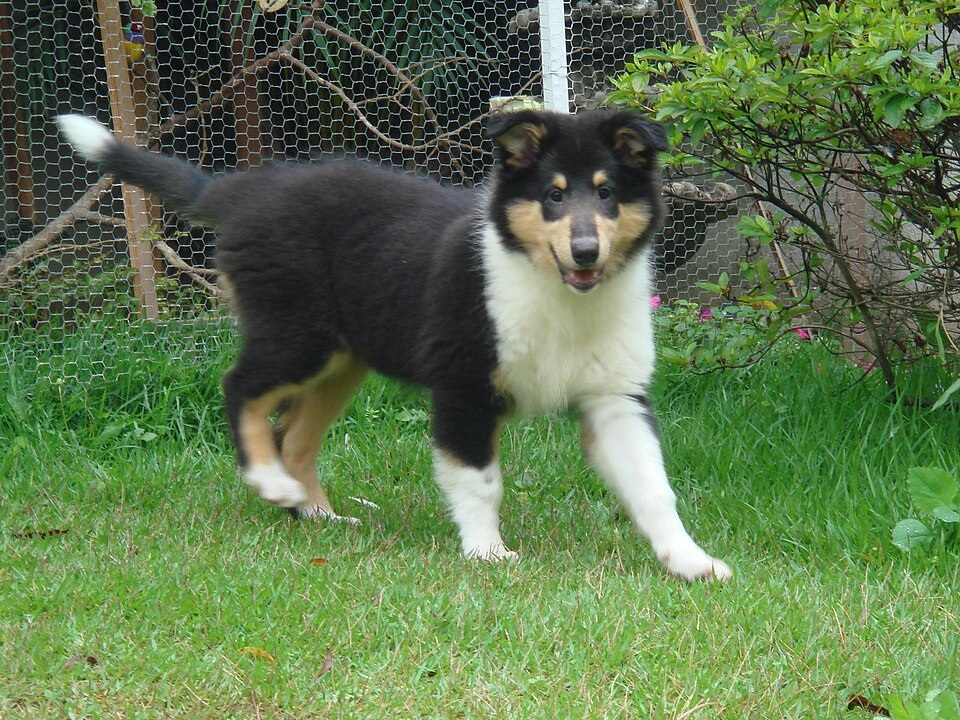
- Additional photograph: Leandro Prudencio / Wikimedia Commons. Original photograph · CC BY 3.0. A Collie puppy walking across a grassy garden. Illustrative photograph.


Leave a Reply